Вибір читачів

.jpg)
During wartime people flee occupation and disinformation. War always brings lies as false claims about victories and defeats, denial of crimes committed by one’s own side and misinformation about the enemy . Therefore when the conflict ends and residents return home, they face new challenges of lies which try to rebuild their lives. Now Ukrainian people living under occupation exist in a propaganda bubble and an information vacuum. In Bosnia and Herzegovina, people resist disinformation such as denial of war crimes, and the glorification of war criminals by returning home. We are trying to figure out how this works through the stories of real people.
WAR TODAY: UKRAINE
A Secret Escape from Crimea
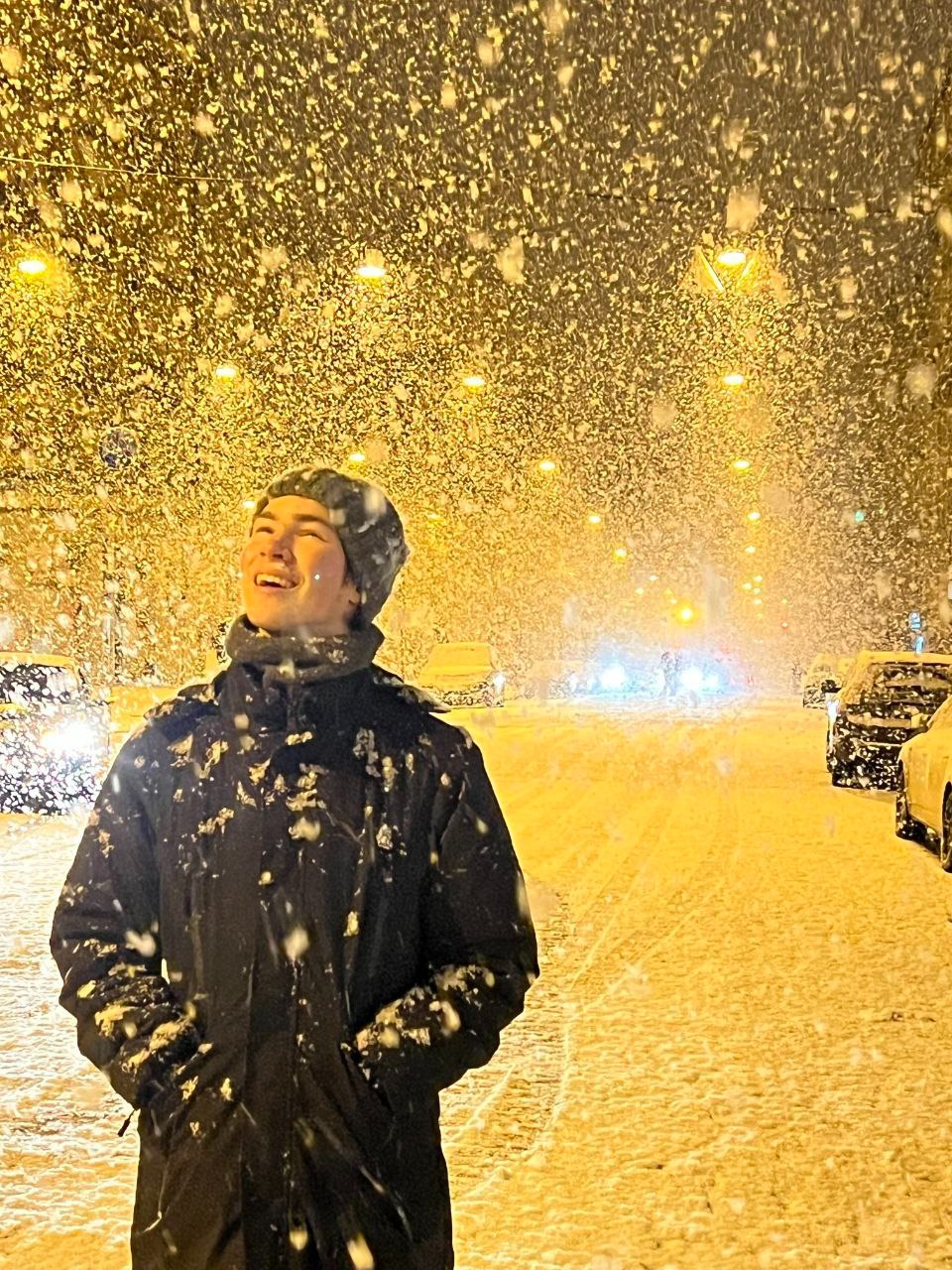
Crimean Artem Zvenigorodsky decided to flee the occupied peninsula. He had already been no fan of imperial Russia, but then he got an extra push when the young man turned eighteen and got a conscription notice to the Russian army. The young man had to hide his secret plan [FTC1] about fleeing to Ukraine even from his mother.
We even had been arguing about it. I said, “I want to go to Ukraine!” She replied, “Don't even bring it up, don't mention it.” My mother was categorically against it. She preferred that I serve a year in the Russian army. She didn't trust Ukraine and was afraid for me. Only when I arrived and told her, ‘Mom, everything is fine with me,’ did she calm down."
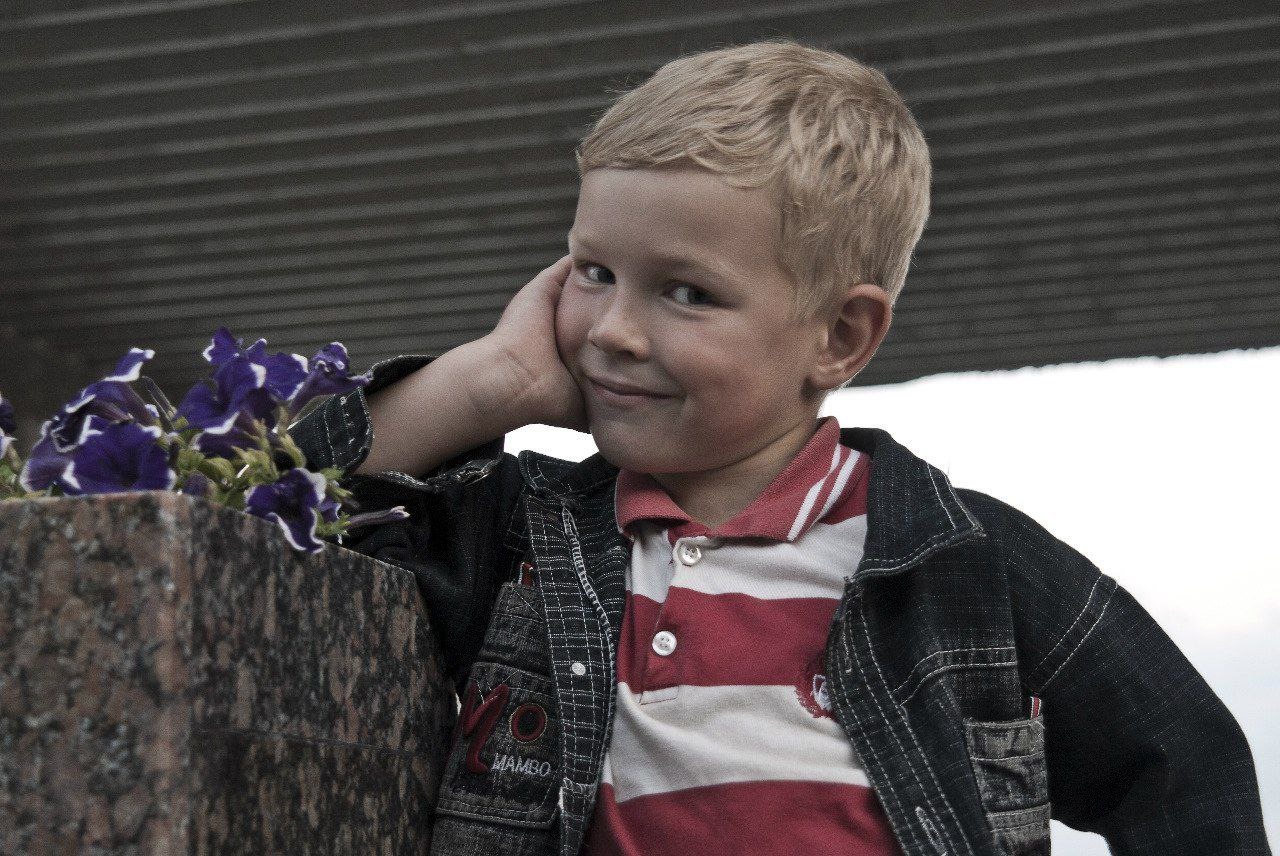
Artem was born in the industrial city Kryvyi Rih, but at the age of five in 2012, he moved with his family to Sevastopol. At that time, no one could have imagined that the city would become an active NAVY base for the Russian Federation, and that Russia's illegal annexation of Crimea was only two years away.
His stepfather, who worked as a photographer, was indeed arrested and sent to prison for twelve years on charges of terrorism.
“The fact that he was transporting fifty bags of saltpeter with some kind of remote control, the police were already there. It doesn’t work that way. Obviously, he was set up. And it’s a shock. I keep my cool on the outside, but for me it's very stressful. It was only in Kyiv that I finally understood the scale of the tragedy. Wow! He's in prison, I can't call him, I don't know if he'll ever get out. And this understanding / realization arrived /came and I was really frozen at that moment, it was just awful."
Artem's stepfather did not hide his pro-Ukrainian position even during the occupation. He allowed himself to participate in Ukrainian groups on social media, and as a result, he had long been on the Russian special services' radar. His public support for Ukraine often led to arguments with his wife.
“You're a silly fool, waiting for Ukraine. There were arguments. It didn't come to blows, but there were some heated discussions.”

Fear Built on Rumours
Artem's mother is a hairdresser. She came to the peninsula so that her son could breathe the sea air and enjoy Crimean nature. According to Artem, his mother is least concerned about which flag she lives under. Even the war has not changed this principle.
“Her position is that no one should touch her. As long as no one touches her, she is happy with everything. She is not a politician, she is not competent in this matter, we don't talk about it. She has nothing to say to me. ”I was in Ukraine" — I earned more, but I don't really want to go back. It's calmer here. When the war started, I said, Mom, look what's happening. She said it's terrible, but there's nothing I can do, we're just some small pawns."
The shelling of military bases in Sevastopol, where his wife lives, did not change his mother's neutral worldview either. Explosions in and outside the city are perceived as routine.
“She doesn’t panic. She says, ‘Be careful.’ She is a person who is completely apolitical. She doesn’t vote. I remember when the train station in Donetsk was bombed. Who do you think is to blame? She says, ‘How should I know who is to blame? A rocket flew in there. I say, the Crimean bridge was blown up. She replies, damn, they blew it up. The same reaction when the Kakhovka hydroelectric power station was blown up. Well, they blew it up. She's not interested in the subject. She lives in Sevastopol and that's it."
However, his mother insisted that her son should stay at home, under occupation, and under no circumstances should he try to come to the territory controlled by Ukraine. This prejudice was based on what she had heard from her closest circle of friends.
"She assured me that if I came to Ukraine, Crimeans would be hated there, beaten for speaking Russian, and when they found out that I had a Russian passport, it would be horrible. They would consider me a traitor there! The environment has a strong influence. Somewhere her friends heard something, somewhere her grandmother, somewhere her matchmaker. It accumulates and is stored somewhere in the subconsciousness."
Artem's mother, like many other people under occupation, fell into the trap of “collective guilt” artificially created by propaganda, according to Igor Akimov, director of the KRONOS Institute for Social Dynamics and Security. This is the most dangerous element of social engineering. The occupier systematically blurs the line between “victim of circumstances” and “collaborator.” The key tool here is forced passportization.
People are made to believe that “if you took your passport, you are a criminal in Kyiv's eyes. There is no turning back.” This is how an artificial community of “betrayers” is formed. The fear of criminal liability for collaboration is exaggerated to the point of absurdity. People are convinced that they face prison even for paying utility bills to the occupation authorities or working as a janitor. This fear cements loyalty to the occupier not because of love for the Russian Federation, but because of the lack of alternatives," says Akimov, head of the KRONOS Institute for Social Dynamics and Security.
Why do people rely on the opinions of relatives and neighbors and try to distance themselves from society and the news? Usually, this is not just passivity, but a deliberate trick by propagandists. A sterile environment is being created in the occupied territory. When there is no access to verified facts, people's minds begin to fill in the gaps with rumors. The occupiers skillfully exploit this vacuum by spreading viral rumors through a network of “eyewitnesses,” such as planted individuals in queues, markets, and public transport.
They share “real-life stories” about how someone was “taken to the Armed Forces of Ukraine straight from their home” or “imprisoned for having a Russian SIM card.” In a closed social group that is in a state of chronic stress, critical thinking is disabled. The echo chamber effect is at work: fear, voiced by one person, resonates and is amplified by others, turning into collective psychosis. One of the goals of the occupation policy is to destroy horizontal ties in society. The system of encouraging denunciations creates an atmosphere of total distrust. Neighbors fear their neighbors. This leads to atomization of society: people shut themselves away in their apartments or families," explains Akimov.
Artem had managed to leave Crimea, traveling thousands of kilometers and passing through several checkpoints. His mother accepted his choice and decision to obtain Ukrainian citizenship. However, his relatives were not so forgiving, with several of them sending him messages saying they were disowning him forever.
“You are no longer my relative because you stood on the Maidan with the Ukrainian flag. I can't stand to look at that.”
When Freedom Feels More Dangerous
Why couldn't Artem's loved ones accept his choice to be Ukrainian? Probably because for years they had been turned against Ukraine and made to believe that returning home was dangerous. The basic method used by the occupying administrations' technologists is mirror projection. They take the real practices of their own repressive apparatus (filtration camps, basements, torture, extrajudicial executions) and mirror them onto the image of the Ukrainian authorities. The mechanism works proactively: residents of the temporarily occupied territories are convinced that the liberation of the territory by the Armed Forces of Ukraine will not bring freedom, but a mirror “purge.” Propaganda shapes the narrative: “If the Russians checked your loyalty to Ukraine so harshly, imagine how harshly the SBU will check your loyalty to the Russian Federation.” This creates a psychological trap: the victim of the occupation begins to fear their liberators more than the occupiers, because the occupier is already a familiar, stable evil, while the return of Ukraine is portrayed as an unknown threat with a potentially higher level of violence.
Based on fear of the enemy, militarization is also becoming part of everyday life, even for children.
“You know how to handle a machine gun, right? You’re a man, you have to defend your homeland. Are you a coward? These ‘brainwashed’ people wrote to me that you’re a coward, that you didn’t go to defend your homeland because you’re afraid. I replied that I went to my homeland because it is not my army, but the army of the occupier. But I still heard – you are a coward. These people are unable to think critically or accept arguments. They have their own music box spinning in their heads.”
Joining the Yunarmiya in Russia is formally voluntary, but in reality, it is a ticket to a comfortable life, offering the chance to get free entertainment trips and easy admission to universities.
“They have captured a piece of an open, successful society. And they approach it from their Kalashnikov ranks and offer bonuses that will appeal to the residents of a typical Russian village,” says Professor Alexander Naboka.
Now, under occupation, systematic ideological work is being carried out with young people. Artem recalls that with the start of the full-scale invasion, a subject called “Conversations about Important Things” appeared in his school schedule.
“It's a very outdated propaganda model that has already turned off the rock ‘n’ roll generation. Not to mention today's youth, who are more sincere in their expressions and are confused by hypocrisy. Their response to such aggressive propaganda is just mimicry,” - says Professor Alexander Naboka who taught history at universities in the Luhansk region and now explores how propaganda works.
But even such blunt methods are effective with younger schoolchildren, according to Artem.
“First and fifth graders have their brains completely washed, they're a mess. You give them arguments, and they respond that it's all fake. They can't be saved.”
But is it really impossible to save them? On the one hand, social behavior experts believe that six months of propaganda “brainwashing” can completely change a person's beliefs.
“This is the ideological cargo 200,” a pro-Russian individual. But you can't change that person's position by any means, even by pointing out the truth," Professor Naboka is convinced.
Family as a Lifeline
However, according to analysts, there is a so-called preserved part of society in the occupied territories, no less than 15% of those who are currently sympathetic to Ukraine and support its development. It is this reactive human capital that they plan to use as a support for mental recovery after the return of the territories. But the question arises: how did they manage to preserve the pro-Ukrainian spirit after more than ten years of isolation?
Igor Akimov: “The answer lies in family relationships. For example, a father lives in Luhansk, a daughter lives in Kyiv, and a granddaughter settled in Warsaw. The father needs to know the conditions in which his daughter and granddaughter live. Therefore, he immerses himself in information channels that reflect not only the reality of Crimea.”
Artyom's mother is now also paying closer attention to what is happening in Switzerland. Her son went there to study after obtaining Ukrainian citizenship. Whether he will return to his homeland or support it from abroad is his next choice. Ukrainian society will face another challenge: how to start living after the complete cessation of hostilities.
AFTER WAR: BOSNIA AND HERZEGOVINA
Russian Denial of Crimes in Ukraine, but also in Bosnia
Russian propaganda, however, has not concerned itself only with the Russian invasion of Ukraine. Since the beginning of the full-scale invasion in February 2022, Russian media have shown a noticeable increase in the denial of war crimes, not only in Ukraine but also on the other side of Europe – in Bosnia and Herzegovina.
More than 100,000 people were killed during the war in Bosnia and Herzegovina between 1992 and 1995, during criminal projects aimed at creating ethnically pure territories carried out by the military formations of the self-proclaimed Republika Srpska and Herceg-Bosna, with the support of Serbia and Croatia.
After the fall of Srebrenica in July 1995, Serbian forces captured and killed at least 8,372 people – Bosniak refugees from the area of eastern Bosnia along Drina river, mostly men and boys, who had found refuge in the enclave during the previous three years. This project of extermination has been characterized by multiple international and national courts – as genocide. The International Criminal Tribunal for the former Yugoslavia, an ad hoc United Nations court established in The Hague, convicted several individuals for genocide in Srebrenica, including the entire political and military leadership of the self-proclaimed Republika Srpska.
For Russian media, however, these crimes represent Western propaganda. International lawyer Marine Maunier identified, in her research for the Srebrenica Memorial Center, a sharp increase in cases of Srebrenica genocide denial in Russian media during 2022 and 2023. Also present in the Balkans, the peak of Russia’s disinformation machinery was the propaganda documentary “Bosnia and Herzegovina: The Rise of the Caliphate”, produced by RT Balkans, filled with lies and disinformation, claiming both massacres in the Ukrainian town of Bucha and the massacres in besieged Sarajevo, the capital of Bosnia and Herzegovina, and in Srebrenica, were staged by the Ukrainian, and Bosnian Government.
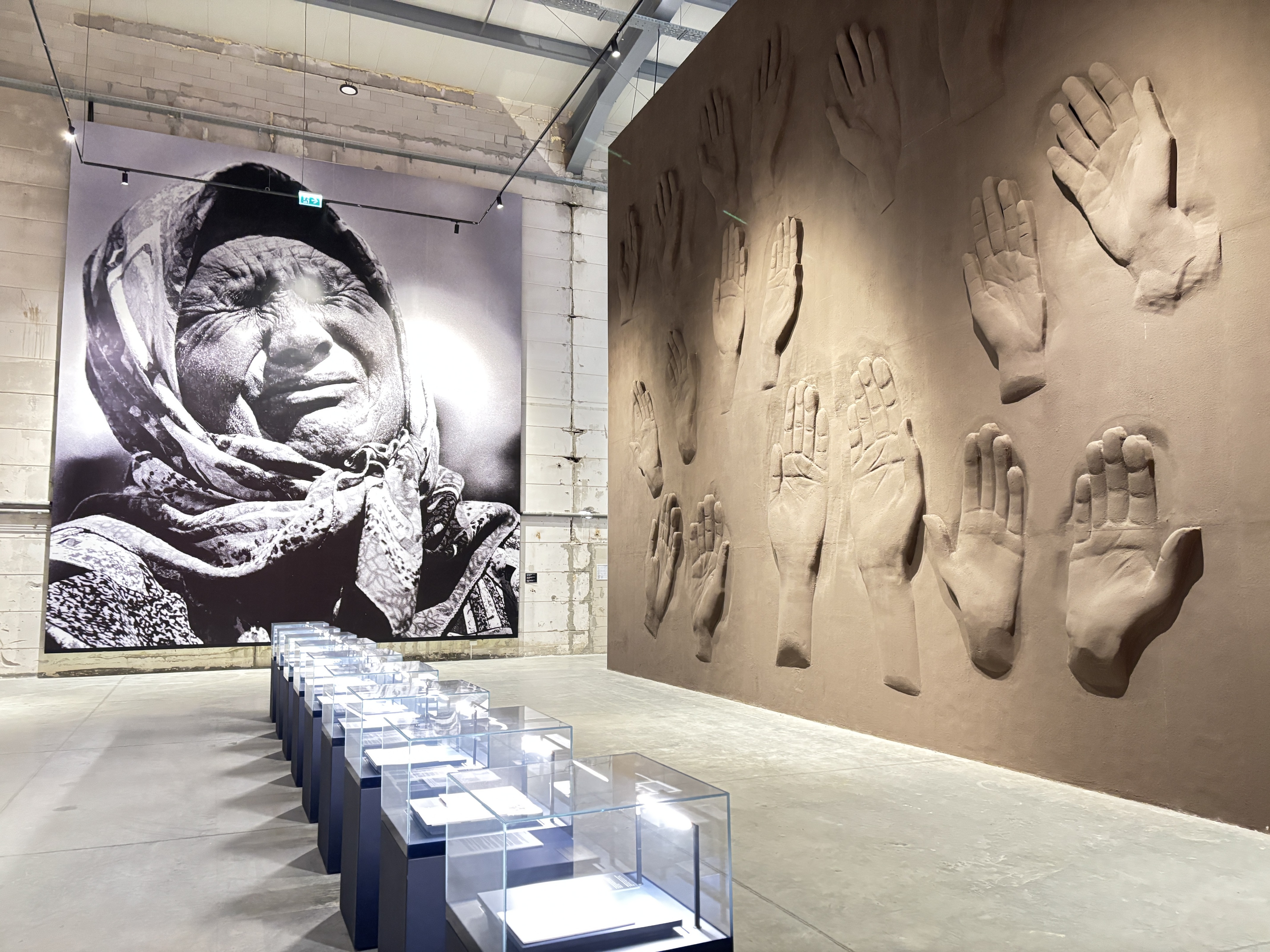
Within Bosnia and Herzegovina, war-related disinformation and propaganda most often appear in the form of genocide denial, but also in the celebration of genocide and the glorification of war criminals – a daily reality present in all segments of society. Alongside institutionalized denial through reports and decisions of the Government of Republika Srpska, today an autonomous administrative entity within Bosnia and Herzegovina, and its prominent political figures, it extends to other layers of society – war criminals are glorified on social media, at football matches, at private celebrations, or on the streets through graffiti. Although the denial of war crimes is illegal, prosecutors in Bosnia and Herzegovina do not do enough to prosecute perpetrators, and many war criminals themselves walk freely.
“My Mother’s Killer Lives There”
After the fall of Srebrenica, Serbian forces killed Hasan Nuhanović’s father, mother, and younger brother. Their bodies were found in mass graves and properly buried at the cemetery of the Srebrenica Memorial Center only many years later – father after 10, mother and brother after 15 years.
Today, Hasan lives in Sarajevo. In the town where he grew up, Vlasenica – located near his father’s native village, and which he must pass through when traveling to Srebrenica to Memorial Center – the man accused of killing his mother lives freely. At least, that is what prosecutors leading the investigation say – Hasan has asked them not to disclose the accused’s identity to him.
“On the way to Srebrenica, I cannot avoid passing through Vlasenica. Every time, I think about the fact that my mother’s killer lives there. In Sarajevo, the trial of the accused will take place in a court building located about two kilometers from my own building. There is simply no escaping it”
Over the past several years, the Srebrenica Memorial Center has regularly published annual reports on genocide denial. During the reporting period from 1 June 2024 to 30 May 2025, a total of 99 cases of genocide denial were recorded in the public media space of Bosnia and Herzegovina and the wider region. Compared to the previous 2024 report, when as many as 305 cases were recorded, a significant decrease is noticeable – likely the result of the first conviction for genocide denial, as well as social pressure generated, among others, by the Srebrenica Memorial Center.
These reports are precisely a way of raising awareness and combating denial by an institution that today employs mainly genocide survivors or members of the families of those killed in it. One of them is Edin Ikanović, who survived the fall of Srebrenica as a child and returned in the mid-2000s with his mother and siblings to the area around Bratunac, to the village from which they had been expelled.
Today, 37-year-old Edin lives in Srebrenica with his wife and two children and works as a researcher at the Memorial Center.
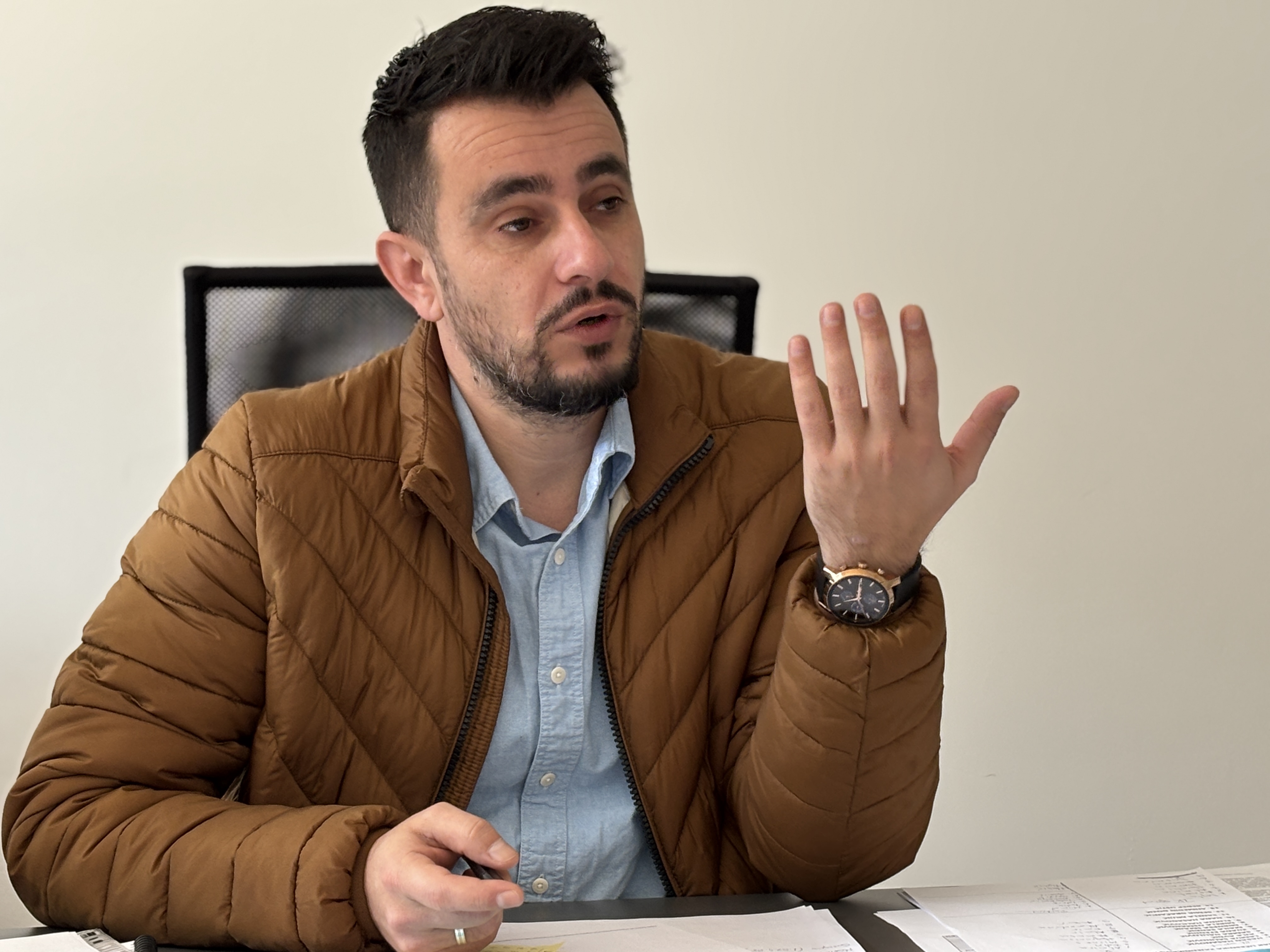
He says he never imagined he would dedicate his life to this work. When he returned, he believed in a different future and an escape from the past. He grew up listening to stories from family members and survivors about the crimes.
“All conversations in the years after the war – in our family, among friends, and within our refugee community in general – revolved around the same thing: what had happened to us, who was killed, who survived, whose body had been found, and in which mass grave…,” Edin recalls.
When he returned, he believed that younger generations, who had not been direct participants in the war, would not carry the burden of those crimes.
“I believed that if I was not burdened by the past, they would not be either, and that we could move forward. But I soon realized that I was wrong,” he continues.
The returnee community in his home village remained tightly knit. His first contacts with Serbian neighbors from surrounding villages and towns came through projects financed at the time by international organizations. Disappointments, however, came very quickly – when the projects ended, the contacts ended as well. But the propaganda continued.
The Topic of the Past Is Mostly Avoided
The first conviction for genocide denial concerned a poster in the center of Bratunac congratulating the birthday of the convicted Serbian army general Ratko Mladić.
“Of course it’s not easy when you see things like that,” Edin says.
On a personal level, discussions about the past are mostly avoided with Serbian neighbors in Srebrenica. The core problem of institutional denial is its impact on everyday life. Edin recounts the story of a five-year-old boy who complained to him, shocked to learn that his friend was Muslim.
“Then why did he give me sneakers a few days ago?” the boy asked, which clearly illustrated to Edin the weight of the propaganda in which the child’s family lives.
Edin is not sure that banning genocide denial in the public sphere can change relations at the level of ordinary people, but he believes it can at least spare survivors from retraumatization.
Denial is also sustained through the widespread discrimination against the Bosniak population in the entity whose authorities try by all means to maintain it as mono-ethnic – in education, healthcare, or public administration, adding administrative obstacles to residence registration, which Edin also fought against for years.
Despite everything, when asked whether he considers leaving Srebrenica, Edin answers no. He returned, he says, because of his deep connection to the area. Working at the Memorial Center is difficult, and he does not believe he will remain there for his entire career. But he does not consider leaving Srebrenica.
Pictures of Genocide Perpetrators Displayed in Public Institutions
Also working at the Srebrenica Memorial Center is Mirela Osmanović, born in 1997 – after the genocide. Born and raised in Sarajevo, she says that until her teenage years she knew little more than that her family was from Srebrenica.
She always felt an immense sadness, and at that time she would learn why – she never had the opportunity to meet her two brothers, whom Serbian forces killed during the genocide after the fall of Srebrenica. They were 15 and 17 years old. Her father spent two months fleeing through the forest from Serbian forces – in the infamous Death March of refugees from Srebrenica – before reaching safe territory.
“My father refused for a long time to believe that someone would kill his sons for no reason. When the Missing Persons Institute asked him for a blood sample for DNA analysis to compare with remains found in mass graves, he refused, believing his sons were alive somewhere”
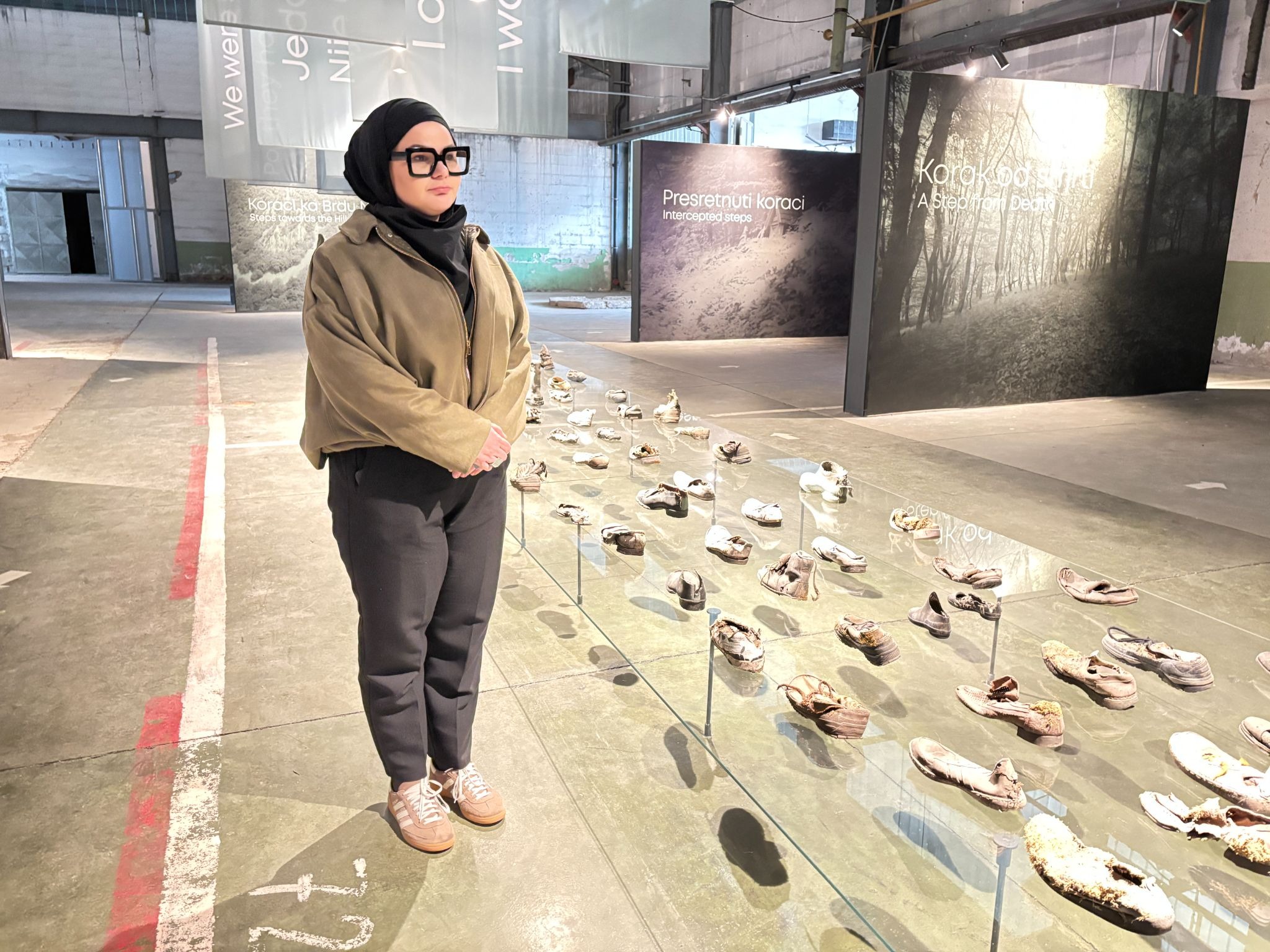
Mirela Osmanović at the Srebrenica Memorial Center
Only later, when the true scale of the killings became known, did acceptance come. Years later, her brothers were found and buried in the cemetery within the Memorial Center complex.
Learning the details about her brothers was Mirela’s first shock. The second came years later, after finishing university, when Mirela – after her parents returned to their village near Srebrenica – first confronted the scale of genocide denial and the glorification of convicted war criminals.
“I was shocked when I saw pictures of the perpetrators of genocide displayed in the municipal building, in public institutions,” Mirela says.
Even more disturbing are suspicions that one of her parents’ neighbors near Srebrenica might be a war criminal – and possibly the killer of her brothers.
At that moment she realized that her life’s calling was to fight for the truth.
“I, a member of a family of direct victims, knew nothing about it. If I do not speak about it, how will others know?” she concluded.
During the political crisis last year caused by separatist acts by the Republika Srpska entity, the Srebrenica Memorial Center briefly closed its doors. Employees were told to go home. Mirela’s father heard about it and, frightened, began searching for his daughter. Memories resurfaced.
“Seeing that, I was direct – let’s all go to Sarajevo immediately,” she suggested to her parents. Despite their fear, they refused. They asked her to leave while they stayed. In the end, they all stayed.
They Offered Him Money Not to Testify, but He Refused
At the other end of Bosnia and Herzegovina, in the south, on the road to the town of Stolac, one can also encounter some of the sentenced or accused war criminals.
Some of them abused Amer Đulić in the Koštana Bolnica camp, he said.
“I was offered 100,000 convertible marks (50,000 euros), a car, and a job not to testify. I refused,” Amer tells us.
Amer concluded that the offer could not have come from an individual – institutions stood behind it, with the intention of concealing the crimes.
Koštana Bolnica (Orthopedic Hospital) in the old town of Stolac in Herzegovina, a region with a Mediterranean climate, had operated for almost 100 years treating bone diseases before the Croatian army (called the Croatian Defence Council – HVO) turned it, first into a headquarters of their Military Police in 1992, and then into a camp for the Bosniak population in 1993.

It was only the first in a series of camps to which Amer was taken as a 17-year-old. The reason – wrong name in a project of ethnic cleansing in areas under the control of Croatian forces. After Koštana Bolnica, he was deported to the Dretelj camp, then Gabela, and finally Heliodrom. He survived.
Koštana Bolnica, however, was the worst.
“Three days in Koštana Bolnica were worse for me than 230 days in other camps”
Without hesitation, he enters the ruined building of Koštana Bolnica in Stolac to show us the rooms where he lay, where he was interrogated, where he was tortured as a young man. Where two of his cousins were killed. His desire to convey the truth is stronger than the discomfort.
The political and military leadership of Herceg-Bosna, the self-proclaimed Croatian territory in Bosnia and Herzegovina has been convicted before the International Criminal Tribunal for the former Yugoslavia for a joint criminal enterprise aimed at creating an ethnically pure Croatian territory within Bosnia and Herzegovina – including through torture and killings in the Koštana Bolnica camp. In addition to them, several individuals were also convicted before the courts of Bosnia and Herzegovina.
Ethnic Cleansing – With Rifles in War, With Pens in Peace
Ethnic cleansing carried out with rifles during the war continued with pens in peacetime, Amer says. The Bosniak population in this municipality, controlled by Croatian nationalists, lives under apartheid-like conditions – from obstacles to employment in public institutions to the refusal to allocate land for a new Muslim cemetery.
The town is divided by an invisible line between the Croatian population and the returnee Bosniak population. Crimes are denied. In this part of Bosnia and Herzegovina, graffiti dedicated to Croatian war criminals – as well as street names – can be seen.

“I don’t want to look away. I walk proudly because I am only telling the truth. They lower their heads,” Amer says about his daily encounters with convicted war criminals in Stolac.
The association of former camp detainees, of which Amer is president, has been fighting for years to turn the ruined Koštana Bolnica building into a memorial center. The local authorities in Stolac obstructs this effort. According to Amer, the reason is simple – they are waiting for the building to completely collapse in order to prevent memorialization.
At the Heliodrom camp in Mostar, the largest city and regional center of Herzegovina, a memorial was unveiled in 2024 – not to the victims of the camp, but to the Croatian Defense Council.
None of this discouraged Amer from returning.
“I came back,” he says, “out of spite.”
However, he sent his son to attend high school in Sarajevo.
“The hardest moment for me was when my son once stopped me while we were about to enter a city bus. He said: ‘No, dad, this is the bus Croats take. Ours is the next one,’” Amer recalls.
He remains in Stolac. He continues the fight to turn Koštana Bolnica into a memorial center.
When asked whether this would truly change relations in Stolac, he answered:
“For us, it would mean everything.”
Olena Solodovnikova, Tarik Moćević
This content was created as part of the project “War and Lies: The Human Cost of Disinformation,” with financial support from the International Organization of La Francophonie (OIF). It is implemented by the Mediacentar Foundation from Bosnia and Herzegovina, After War from France, and the Institute for Regional Press Development from Ukraine. The content is the sole responsibility of the authors and does not necessarily reflect the views of the OIF or the organizations implementing the project.